
Searching Mecklenburg County Criminal Dockets
The North Carolina eCourts Portal is the public entry point for a Mecklenburg County criminal docket search. Pick Smart Search. It opens the Case Summary. That view is also called the Register of Actions. The Mecklenburg location filter narrows statewide results when needed. Smart Search takes a record number, party name, attorney, citation number, or other supported criteria. Criminal Actions is the advanced case category that fits. Mecklenburg rides this statewide path because its state-court records sit with the Clerk of Superior Court. So no separate municipal database exists for a city citation or a county criminal setting.
A full number works best. Enterprise Justice formats it as a two-digit year, case-type letters, a six-digit sequence, and a three-digit county identifier. The state shows it as 21CR000003-910, an official generic example rather than a Mecklenburg sample. For name searching, the Portal wildcard rule asks for at least three last-name characters plus *. Use one character plus * for a first-name wildcard.
- Open Portal and select Smart Search, then enter a full record number when it is available.
- For a name search, enter the most precise available name and use the Mecklenburg location filter to avoid treating another county’s result as local.
- Open Advanced Filtering Options and select Criminal Actions when case type, status, or filing dates help distinguish results.
- Open the matching Case Summary and compare Case Information, assignments, parties, events, hearings, and dispositions in date order.
- Use Search Hearings for a current setting, then consult the local schedule or the appropriate Mecklenburg County confirmation channel if the date is important.
Note: A Portal result is only an informational case view. A certified document from the Clerk follows a separate request and fee process.
Mecklenburg Criminal Docket Events in Portal
Portal's official training materials lay out the parts you may see in a Case Summary. Start with Case Information and Assignment Information. Confirm the parties next. Then set Case Events beside Hearings and Dispositions to read a Mecklenburg criminal docket in order. Financial Information shows up only where it applies. Documents appear only where public access allows. A missing panel does not prove a case is sealed. It also does not prove a financial obligation never existed.
| Portal control | Useful criminal-docket use | Official limit |
|---|---|---|
| Smart Search | Find the Case Summary by record number, name, attorney, citation, or advanced criteria. | One search criterion is required; statewide results may need the Mecklenburg filter. |
| Criminal Actions filter | Narrow an advanced search to the public criminal case category. | Restricted information does not become public through a filter. |
| Search Hearings | Check a current hearing by case, party, attorney, courtroom, or date range. | Compare a case-specific hearing with local schedules when timing matters. |
| Case Summary | Read the dated case register, assignments, hearings, dispositions, and available financial details. | Only sections with available data display. |
No Portal account is needed to search public information. Registering adds the My Cases convenience feature, nothing more. It grants no access to restricted categories or nonpublic data. So the public case view helps you find the court matter. The Clerk remains the office to visit. Ask there for a paper file, a copy, or a certification. In Mecklenburg County, the Portal is one channel among several. The Clerk counter, a public terminal, posted schedules, and direct caseflow confirmation round out the local options for a court docket check.
Inside a Mecklenburg County Criminal Docket
A Mecklenburg County criminal Case Summary is a dated register, not a story. Each field deserves a careful read, the state's training description makes clear, especially when you must tell a hearing or outcome apart from an earlier event. A calendar label is a setting. A charge-related entry is a charge entry. Neither counts as a final result. Check the Dispositions section and the later events on the docket.
| Case identity | Case number, core case information, and assignment information. The system’s full-number structure is illustrated by 21CR000003-910. |
|---|---|
| Parties | Party information that is publicly available. The Portal’s public search result does not return victim-name searches. |
| Case Events | Dated entries that can reflect filings, hearings, or disposition-related activity. Read them chronologically. |
| Hearings | Scheduled court events. Search Hearings is the current-calendar complement when a date needs confirmation. |
| Dispositions and money | Recorded outcome or status information and Financial Information when the case has applicable data. |
| Documents | Records or documents where Portal makes them available and no law or court order restricts access. |
Need a certified item instead of a screen view? The Judicial Branch records guidance sends you to the Clerk's office in the county where the case sits. That distinction matters for a certificate under seal. It applies whenever a court, an agency, or an individual requester wants that rather than a plain Case Summary.
The Mecklenburg County criminal Case Summary helps you name the exact entry to ask for. The Mecklenburg County Clerk then decides the copy or certification channel for those court records.
Mecklenburg Criminal Docket Codes and Reporting Labels
Mecklenburg County criminal activity comes wrapped in three state labels that trip people up. The county activity reports split them this way: CR for criminal District Court, CRS for criminal Superior Court, and IF for infractions. Those labels point you to the right court layer. The Portal posts no Mecklenburg-specific event-code legend. Read the wording displayed on the Case Summary itself. Do not guess at abbreviations. Guessing is how misreadings of a criminal docket start.
- CR
- Criminal District Court label used in state reporting and case-number context.
- CRS
- Criminal Superior Court label used in the state county activity report.
- IF
- Infraction case label used in the state county activity report.
- FTA
- Failure to appear in the Clerk’s certified-search form glossary; check the displayed case description before applying it to a Portal event.
- Calendar call
- A session-management event for an upcoming term, not a final disposition.
The county criminal and infraction activity reports track filings, dispositions, and pending cases by county and category. That makes them good context for Mecklenburg County criminal dockets. They are never a stand-in for a case-specific Case Summary. The reporting labels sort court categories. The Mecklenburg County Case Summary, meanwhile, supplies the dated facts of one particular criminal matter. The state reporting page separates District criminal, Superior criminal, and infraction entries. You should read a Mecklenburg County court record the same way.
Keep the three categories apart. District criminal, Superior criminal, and infraction entries each mean something different on a Mecklenburg County court record, and the state reporting page draws those lines for a reason.
How a Criminal Case Moves
A criminal register follows a predictable arc. It usually moves from charge and initial case information through assignments, hearings, motions or filings, and a recorded resolution. The Portal sections let you follow that sequence. What they do not do is license guesswork. A short label alone cannot support an inference of an indictment, plea, or conviction. Open the dated event first. Then compare it against the later Hearings and Dispositions on the docket.
Docket flow: Filing → Arraignment → Pretrial → Plea or Trial → Disposition → Sentencing.
Read a trial-order line for what it is: a scheduling slot, never a finding of guilt. A continuance just pushes a setting back. A reset slides it to a fresh date. None of those entries settles anything about the charge itself, so before you rely on an older event line in a Mecklenburg County criminal docket, look at the most recent case-specific hearing entry instead.
Local trial orders and a case summary do different jobs here. The order lays out how a court session is organized; the summary gives you the case-by-case chronology a docket reader actually needs.
Mecklenburg Criminal Docket Setting Confirmation
Mecklenburg County gives the public several ways to confirm a criminal setting. Search Hearings provides the case-specific electronic view. The local administrative schedules add session, assignment, and trial-order context around that hearing record. A schedule category tells you which court is sitting that day. What it cannot do is replace the hearing record for an individual case, so confirm the setting itself before you count on any listed category.
When a setting looks stale: Treat the most recent case-specific hearing as the working information, then confirm it with Caseflow Management at 704-686-0185, a Superior criminal coordinator at 704-686-0143, 704-686-0189, 704-686-0193, 704-686-0192, or 704-686-0311, or the Clerk at 704-686-0400.
For a full picture of scheduling channels, the county's Caseflow Management page is the local source. It helps most with trial orders. A label might read preliminary, homicide, habitual felon, or special victims. Those names describe how the Mecklenburg County calendar is organized, not a disposition. Labels explain the session. The current criminal hearing is still the item to confirm on the individual record.
Courts That Hold Criminal Dockets
Mecklenburg County does not split criminal cases between county criminal courts and a municipal court. One unified General Court of Justice handles everything. The Mecklenburg County Clerk of Superior Court keeps the docket for both local trial-court divisions. District Court takes misdemeanor, traffic and infraction, first-appearance, and administrative criminal settings. Superior Court, District 26, handles felony trial and felony-administrative matters. So a docket search starts with the division, not with separate clerks.
| Mecklenburg court layer | Criminal docket context | Where to begin |
|---|---|---|
| District Court | Misdemeanor, traffic/infraction, first-appearance, and administrative criminal matters. | Portal, Search Hearings, local schedules, or the Clerk. |
| Superior Court, District 26 | Felony trial and felony-administrative matters. | Portal and schedules, followed by the criminal coordinator or Clerk when confirmation is needed. |
| North Carolina Court of Appeals | A separate appellate docket if a trial-court matter is appealed. | Do not assume an appellate case is a second Mecklenburg trial-court Case Summary. |
When a case or an older filing does not show up online, the Mecklenburg County Courthouse is the in-person fallback, with public terminals and paper-file access. Since the county runs one unified court location, a Mecklenburg County search should follow whichever division the record shows rather than hunting for a separate local criminal clerk. That division line is the whole map.
Mecklenburg Criminal Dockets after October 2023
Mecklenburg County moved onto eCourts on October 9, 2023. The switch brought Portal, Odyssey, and File & Serve eFiling with it. The Judicial Branch launch announcement spells out what Portal covers for the public: case information, records, documents, hearings, and eligible payments. Attorneys and parties file electronically through File & Serve. That service is for filing work. It is not for reading a criminal docket as a member of the public.
October 2023 marked a real split in how Mecklenburg County handles criminal dockets. Documents filed before the conversion may not sit in Portal. That gap does not mean the record is gone. When a pre-conversion item is missing, the county asks requesters to email the criminal Clerk division with a few details. Include the record type, the party name or names, and the file number if known. That email route is the bridge for older Mecklenburg County criminal docket material. So treat October 2023 as a retrieval line. It is not proof that an earlier case vanished.
Sealed Dockets and Public Access
G.S. 7A-109 puts Clerks in charge of court records, files, dockets, and indexes, and it generally opens those records to public inspection during regular office hours unless a law blocks access. Portal is a convenience for Mecklenburg County. It is not the only route. When an online search comes back empty, try a courthouse terminal, ask to inspect the paper file, or inquire with the Clerk. A blank result does not mean no record exists.
North Carolina access boundaries:
G.S. 7A-109 keeps Clerk records and dockets open to inspection except where access is legally limited.
G.S. 7B-3000 withholds juvenile records from ordinary public inspection, subject to defined access and court-order rules.
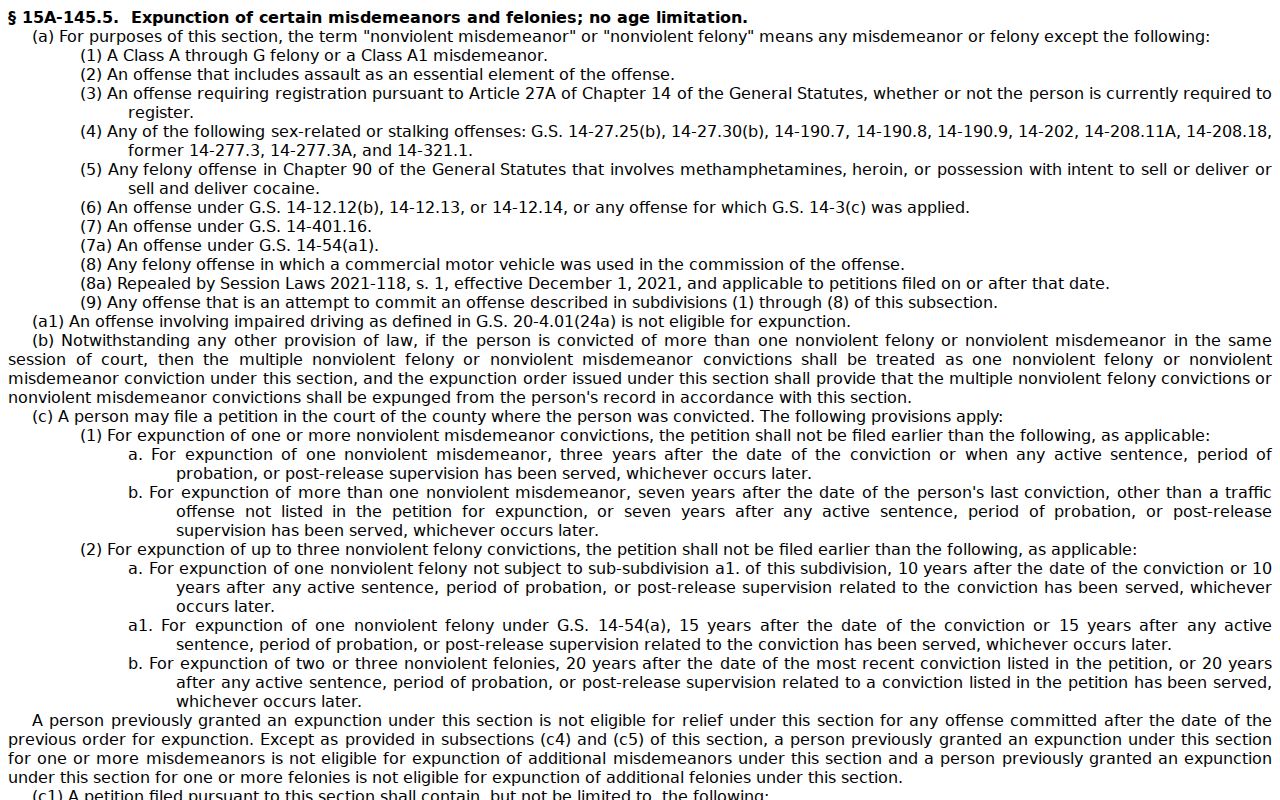
G.S. 15A-145.5 is one statutory expunction route for qualifying nonviolent convictions.
The official expunction statute supplies the legal source for a qualifying criminal-record petition.
An expunction is a statutory petition filed with the Clerk in the county of charge or conviction. It is not an ordinary request to view a public case. The Judicial Branch's expunction guidance walks through that court process and what it does to access.
Juvenile matters, sealed records, protected documents, and expunction-affected files stay outside ordinary public Portal access. Creating an account does not change that. In Mecklenburg County, the same access limits apply to the criminal record whether your question starts online or at the Clerk's office. The docket search simply will not display what the law shields.
Mecklenburg Recovery Court and Criminal Dockets
Mecklenburg County Recovery Court shows why program participation and a criminal docket should stay separate in your mind. The official contact directory lists Drug Treatment Court at 980-314-1950. The Judicial Branch marked the Mecklenburg program's 30th anniversary in 2025. The court offers no separate public specialty-court docket portal and no distinct public case-number scheme. The Recovery Court anniversary release describes the program's local milestone. For the court record, search the underlying Mecklenburg case in Portal. Then confirm any current setting or program question with the program or the Clerk. Treatment details and restricted supporting material are not public by default. Do not assume you can read them.
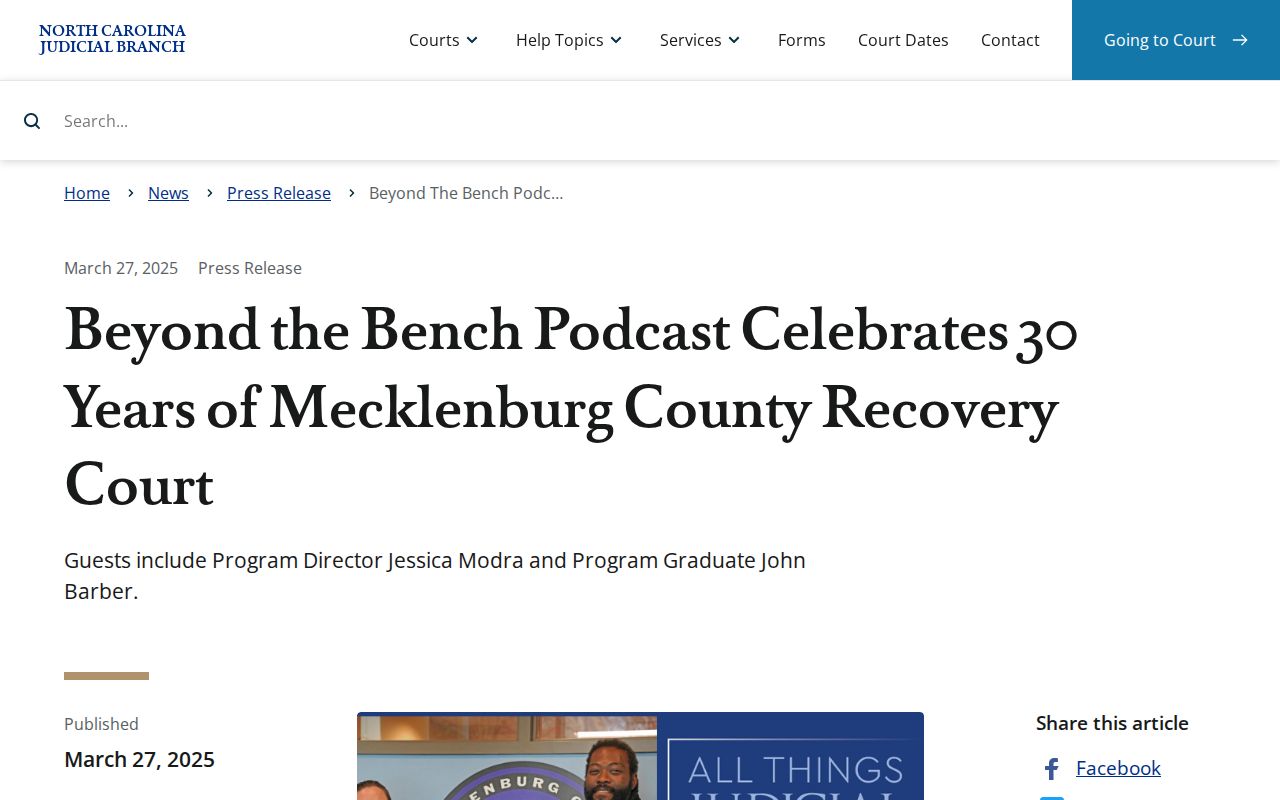
The program's history adds color to a Mecklenburg County criminal docket. It does not change who keeps the record. That job stays with the Clerk. Mecklenburg County Recovery Court does not replace the criminal Case Summary as the public route to the underlying case. One caution belongs here. A public Case Summary can identify court activity. It does not establish every detail of a participant's status or treatment record, so read it for what it shows and nothing more.