
Getting Mecklenburg County Court Records
Every local trial file, Superior or District, sits with one office. That office is the Mecklenburg County Clerk of Superior Court. The free starting point is the public North Carolina eCourts Portal. Its Smart Search tool pulls up a Case Summary or Register of Actions. Search Hearings confirms a current setting. That result gives you the case number and record type before you contact anyone. Still, a Portal view only covers material the public can see there. A full file, certified copy, transcript, or older image may need a different Mecklenburg channel.
At the courthouse, anyone may inspect paper files. The self-service terminals also work during Clerk hours. Call 704-686-0400, listed in the Mecklenburg contact directory, to confirm the record and its fee before you go. Older matters need a separate step. A criminal, civil, or estate-special-proceeding document predating the eCourts conversion goes through the division email route. That route is listed on the Mecklenburg county location page. NCAOC policy also allows online, mail, and in-person requests for agency administrative records. That path never replaces the Mecklenburg Clerk for certifying a county case file.
- Search Portal by case number, citation number, or party name and select Mecklenburg in the location filter when needed.
- Decide whether the need is a Case Summary, a filed public document, a certified copy, an exemplified record, audio, or a transcript.
- Use the courthouse terminal or Clerk counter for a public file that is not available online.
- For an older missing document, send the record type, party name or names, and file number if known to the published Mecklenburg Clerk division.
- Call before ordering to confirm the fee, payment method, and whether a restriction affects the requested item.
Note: A Portal screen view helps you locate a Mecklenburg case. It is not a Clerk-certified court record.
Mecklenburg Clerk Court Record Path
Mecklenburg keeps things simple. There is no split among a county clerk, a district clerk, and city courts. One office, the unified Clerk of Superior Court, serves as the Mecklenburg docket keeper. It handles felony and major civil Superior Court matters, plus District Court misdemeanors, traffic, family, small claims, estates, and special proceedings. Because of that structure, the division and case number matter far more than guessing which office holds a record. Two tools serve different jobs. File & Serve eFiling handles accepted party filings. Portal is the public route for reading available case information.
The Judicial Branch’s court-records help topic describes the statewide records framework used by the Mecklenburg Clerk. 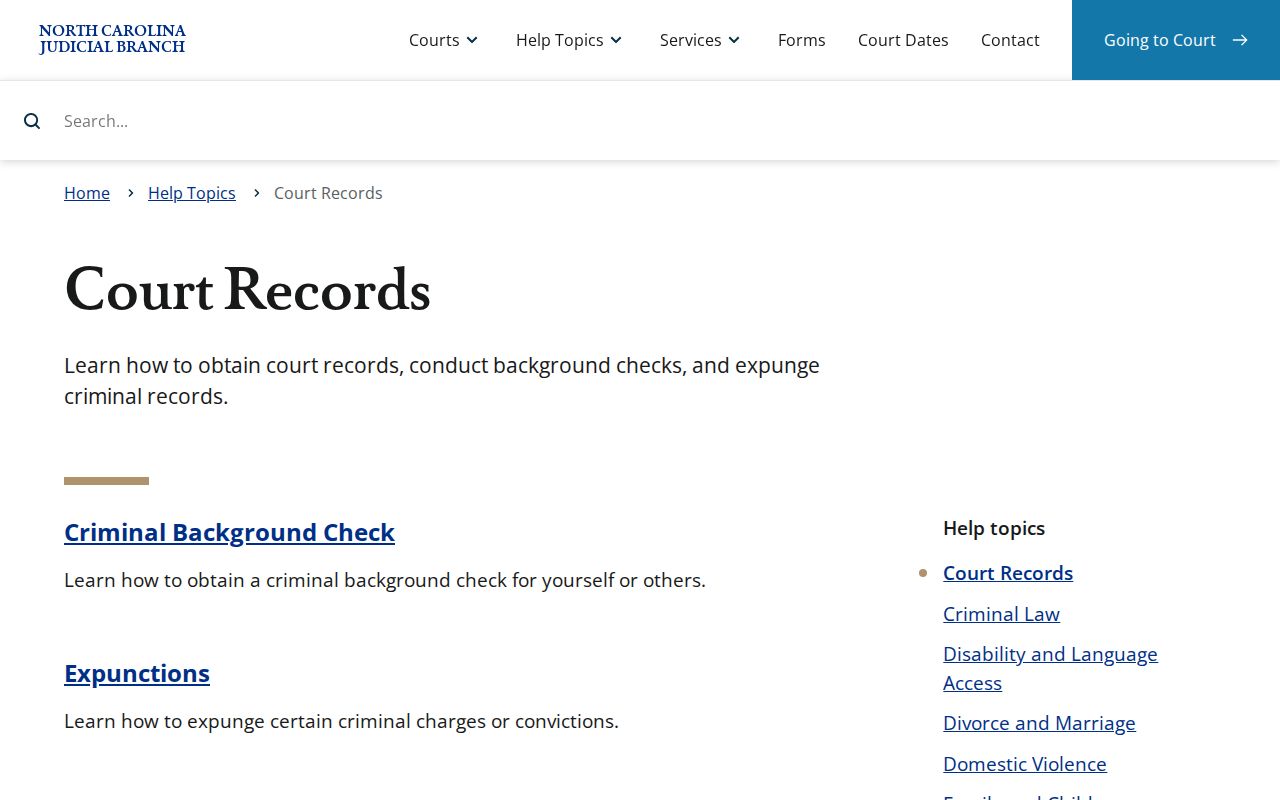 The distinction between the searchable Case Summary and the Clerk-held court file helps a Mecklenburg requester ask for the right item from the start.
Court Record Types
"Court record" covers several distinct things. The Case Summary is a chronological account of case information and events. A filed document is the underlying petition, motion, order, or judgment. You view it through Portal or the Clerk file when public access permits. Then there is the certified copy. That is a Mecklenburg Clerk-issued document or certificate under seal. Which one you request depends on the goal. A current date, the actual filing, proof under seal, a verbatim transcript, or a nonconfidential District Court audio copy each call for a slightly different ask.
- Case Summary or Register of Actions with case events, hearings, and dispositions
- Filed public documents such as petitions, motions, orders, and judgments
- Clerk-certified copies and certificates under seal
- Exemplified records requiring a higher level of authentication
- Transcripts ordered from the court reporter or transcriptionist
- Nonconfidential District Court audio requested on AOC-G-114
Older Mecklenburg Court Documents
Treat October 9, 2023 as a practical Mecklenburg records boundary. It is not proof that earlier cases vanished. The county warns that a criminal, civil, or estate-special-proceeding document filed before the eCourts conversion may not appear in Portal. When it does not, use the published division-specific email route. Include the record type, party names, and file number if known. The county promises no guaranteed turnaround, no universal identification rule, and no standard online docket-copy form. Confirm those details with the Clerk.
Official guidance on obtaining court records explains why the terminal and county file remain important when an online result is incomplete. 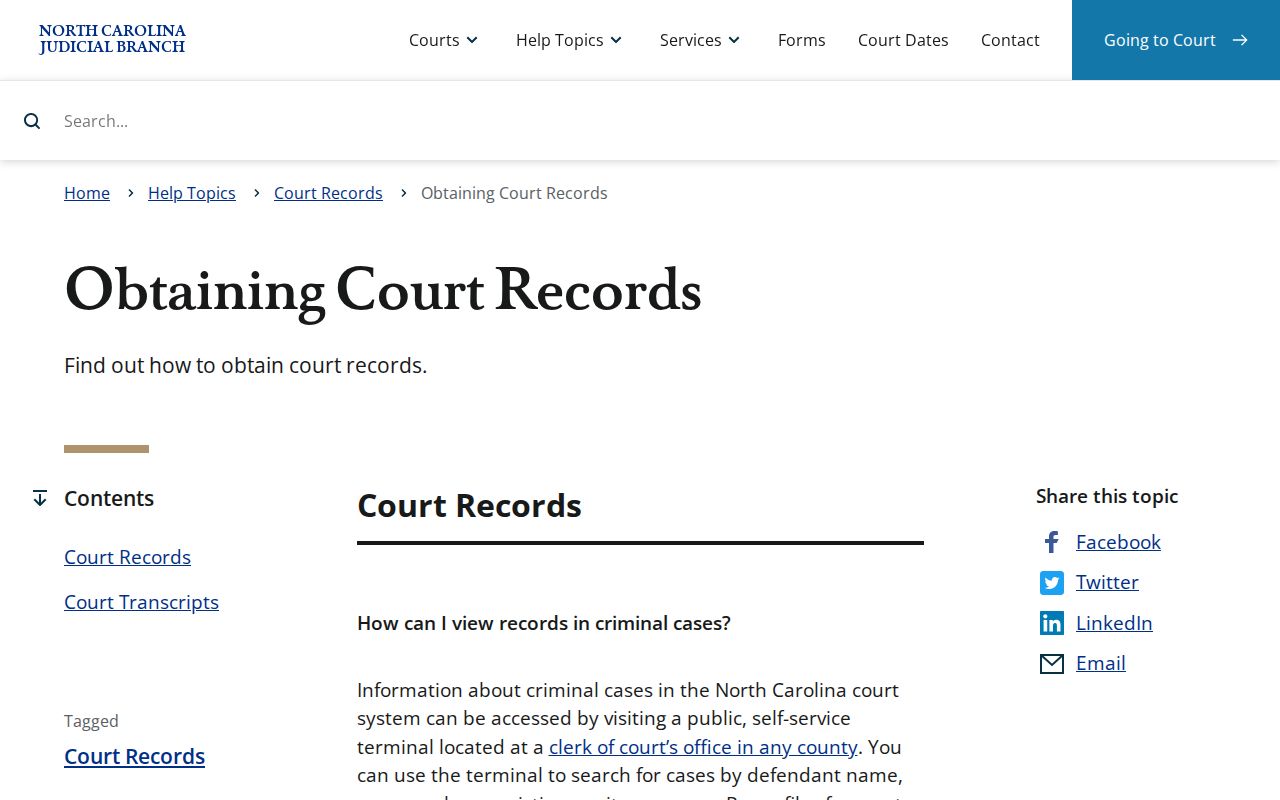 The Mecklenburg terminal route is especially useful when a document needs to be inspected before deciding whether to pay for a plain or certified copy.
Inside a Mecklenburg County Court Record
A Portal Case Summary gathers available Mecklenburg case information rather than reproducing the whole court file. Read it in order. Start with case and assignment information. Then set the events beside the hearings, dispositions, and financial-information sections. Civil, family, probate, and mental-health matters may also show causes of action. A blank panel usually means nothing exists for that category. It does not, by itself, prove the Mecklenburg matter is sealed.
| Case number | The most precise Mecklenburg search key. Enterprise Justice uses year, case-type letters, sequence, and county identifier, such as 21CR000003-910. |
|---|---|
| Case Summary | The chronological Register of Actions and recorded case events. |
| Hearings | Scheduled court events; Search Hearings is the current-calendar complement. |
| Dispositions | Recorded outcome or status information, distinct from a payment entry. |
| Documents | Available filings or records, subject to law, redaction, and court-order limits. |
| Financial information | Applicable costs, fees, restitution, or other monetary information when the section exists. |
Want the fullest Mecklenburg record? Compare the Portal result with the Clerk file. A result list alone is never the complete court file.
Mecklenburg Court Record Summary Limits
Portal is a convenience, not the only official Mecklenburg record path. Anonymous users can search publicly available information without registering. An account merely adds the My Cases convenience, not broader access. Restricted case types stay hidden regardless. The real comparison is between a case summary and a Clerk copy. The summary tracks the public chronology. The Clerk copy is the local record service you need when a document or certification is required.
| Need | Mecklenburg starting point | When another channel is needed |
|---|---|---|
| Case history or date | Portal Smart Search or Search Hearings | Use the Clerk terminal or counter if the record is unavailable online. |
| Public filed paper | Portal case page | Inspect the local Clerk file or ask the correct old-record division. |
| Certified item | Clerk of Superior Court | State the exact document and that certification is requested. |
Fees and Certified Copies
A plain copy is not a certificate under seal. G.S. 7A-308 sets the charges. Preparing the first page of each document costs $2. Each additional page or fraction costs $0.25. A certificate under seal adds $3 on top of the copy preparation. An exemplification runs $10 plus applicable work. The statute also lists a $25 county criminal-record name search. That fee covers neither viewing a Portal case summary nor inspecting a particular Mecklenburg docket. Treat it as its own separate service.
The Judicial Branch’s court-costs page is a useful current reference before placing a Mecklenburg order. 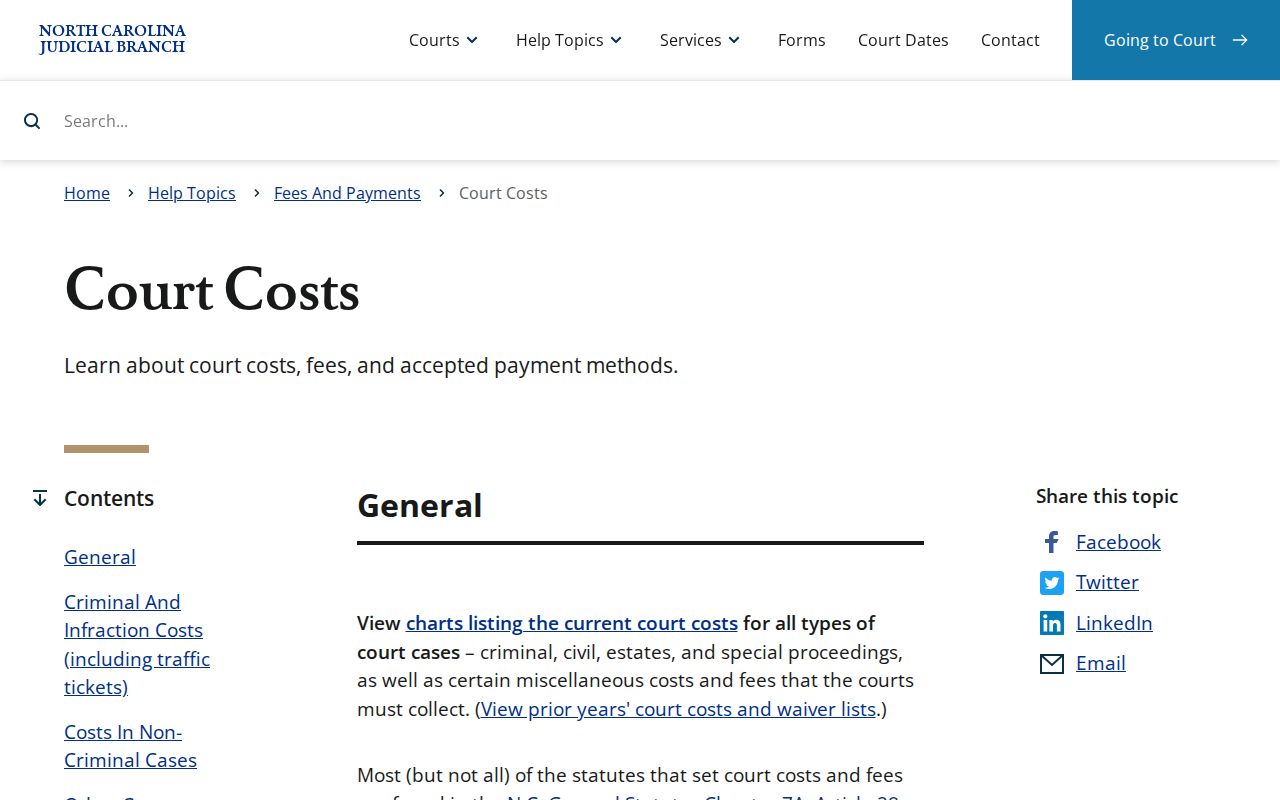 Confirm the total and payment method with the Clerk because the exact request can include copy preparation beyond the statutory seal or exemplification amount.
| Mecklenburg Clerk service | Statutory amount |
|---|---|
| First copied page of each document | $2.00 |
| Each additional page or fraction | $0.25 |
| Certificate under seal | $3.00 |
| Exemplification | $10.00 |
| County criminal-record name search | $25.00 |
Mecklenburg County Clerk of Superior Court
832 E. Fourth St.
Charlotte, NC 28202
704-686-0400
Mecklenburg Court Record Audio Requests
In Mecklenburg County, a transcript and an audio copy travel two different roads. A transcript is a word-for-word account. The court reporter or transcriptionist who prepares it sets the fee. The Clerk treats it as something other than a routine document copy. Audio works differently. The AOC-G-114 form collects the county, the case name and number, the proceeding date, the presiding judge, the courtroom, and your own contact details. It works for a nonconfidential District Court hearing. Juvenile matters and other confidential proceedings do not qualify. The media or copy-log cost still applies.
The copy and certification amounts appear in G.S. 7A-308. 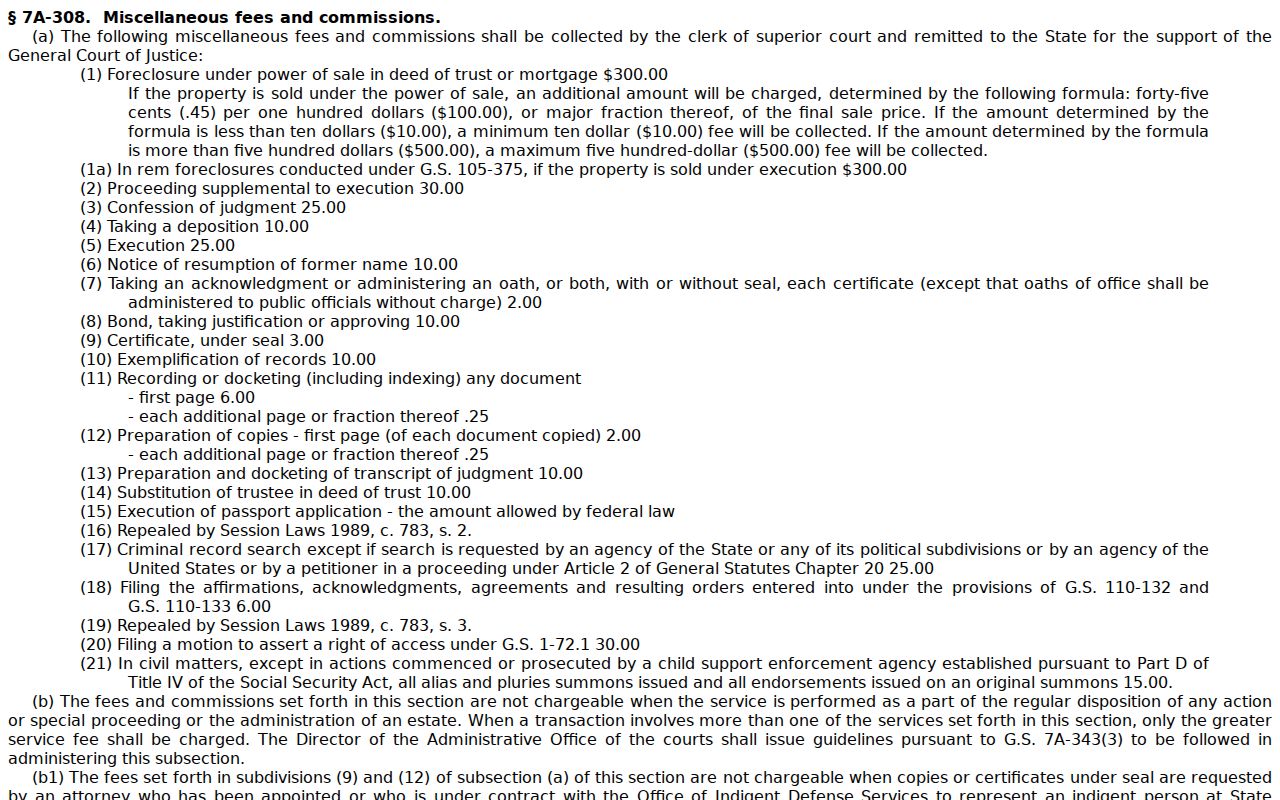 This distinction prevents a Mecklenburg requester from asking the Clerk for a transcript when the correct contact is the reporter or transcriptionist.
Sealed Records and Public Access
Under G.S. 7A-109, Clerks must keep records, files, dockets, and indexes, and the public may inspect them during regular hours unless another law says no. That rule opens the door to a Mecklenburg court file. It does not sweep away every limit. Juvenile, adoption, sealed, redacted, and otherwise protected material stays off limits, and a court can black out confidential portions before releasing anything. Sealed items come out only through legally authorized access. One more caution belongs here. A Portal search that returns nothing does not prove a Mecklenburg case never existed, nor does it tell you the case's legal status.
North Carolina access rules:
G.S. 7A-109 requires Clerk recordkeeping and supports public inspection except where access is legally restricted.
G.S. 1-72.1 provides a procedure to assert an access claim for a civil judicial record.
G.S. 7B-3000 withholds juvenile records from ordinary public inspection except for authorized access or court order.
Mecklenburg Court Record Access Rules
Start with the framework. The North Carolina public-records law overview lays out the rules on inspection, copying, and redaction. The Clerk remains the local source for Mecklenburg court-file copies and certifications. When access to a Mecklenburg civil judicial record is disputed, G.S. 1-72.1 allows a limited motion asking the court to decide the claim. That route is not the same as an ordinary request for a public court document.
Mecklenburg access also has a sensible working order. Portal can point you to a record that exists. The courthouse terminal serves as an in-person fallback. The Clerk handles copy and certification requests and can walk you through them. Agency administrative records go through the NCAOC public-record process. It accepts online, mail, and in-person submissions. Court-case documents stay with the Mecklenburg Clerk in the county of filing. That is especially true where a seal, a file inspection, or a pre-conversion document is involved.
Note: Verify a Mecklenburg court record with the Clerk. Do not rely on a copy, certification, or Portal result for an official purpose.