
Searching the Charlotte Court Docket
Charlotte docket information lives inside the Mecklenburg arm of North Carolina's unified court system. The public starting point is the North Carolina eCourts Portal. Charlotte does not appear there as its own court location. When a statewide result list runs long, apply the Mecklenburg filter. Smart Search then opens the public Case Summary, the state's chronological Register of Actions, for whatever case information is openly available.
Precision matters most here. A Charlotte case number or citation number is the cleanest key. A party-name search works too. Portal rules allow a last-name wildcard after three characters plus an asterisk. A case-number wildcard needs four characters plus an asterisk. Read any Charlotte court docket result with care. A matching name does not settle identity, and a missing panel may just mean no data exists.
- Open Portal and select Smart Search for a Charlotte court docket or Case Summary.
- Enter a citation number, case number, or a focused party-name search.
- Use advanced filters to select Mecklenburg and, when useful, a public case category.
- Open the Charlotte-related result and read its Case Events, Hearings, Dispositions, and Financial Information where shown.
- Use Search Hearings or the Clerk when a Charlotte court date needs current confirmation.
Note: Portal shows publicly available case information, and restricted material stays out of reach for an ordinary public search.
Charlotte Court Docket Route
Charlotte has city government services. But its state trial-court records never pass through a Charlotte municipal docket. A traffic citation, misdemeanor, felony, civil matter, estate, or family case filed in Charlotte routes into Mecklenburg's court structure instead. The Mecklenburg County Clerk of Superior Court keeps the local court records for both the District and Superior Court divisions. That single-clerk setup is why a Charlotte court docket search starts with Portal or the Clerk. It does not start at a City Hall court counter.
District Court is the usual division for traffic and infractions, misdemeanors, family cases, and small claims. It also covers the lower civil tiers. Superior Court takes felonies and major civil proceedings. A case can shift divisions as it develops. Whatever happens, the Mecklenburg Clerk and Portal remain the docket route. This is a custody question only; it does not mean a city agency lacks separate administrative material.
Charlotte Municipal Court Basics
No Charlotte Municipal Court docket exists in any official source. The heading reflects a common search phrase, nothing more. State courts hear the matters people associate with a city court. A ticket written in Charlotte does not become a municipal court record. Where it happened does not change that.
The Mecklenburg Board of Elections office list shows the Clerk of Superior Court. It is a countywide elected office. That matches the unified record path for Charlotte cases. The county Clerk holds the file, not a city clerk. Superior division cases still run through the same state Portal and Clerk route.
The countywide office list lays out that elected-official structure on the official elections page.
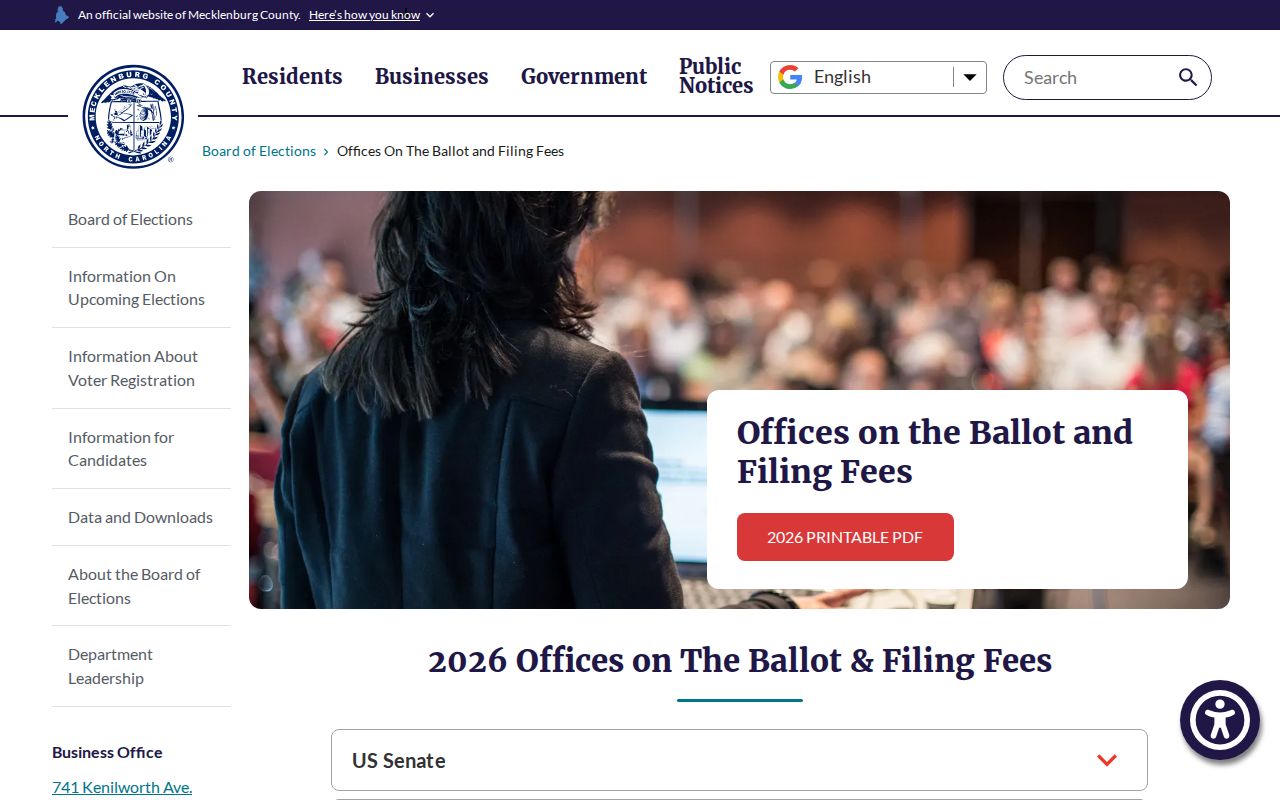
That countywide structure is why a Charlotte court record has no separate municipal-court filing path.
Charlotte City Hall Court Files
The City of Charlotte Clerk page hands court questions elsewhere. It points you straight to the Mecklenburg Clerk of Court. That includes court dates, appearances, traffic tickets, jury duty, divorce decrees, wills, and estates. City government does not keep the state trial-court case file. So a Charlotte court docket search may start at a city contact page. It still ends at the county Clerk anyway.
City Hall suits a city administrative question. It cannot pull up a Case Summary or issue a state-court copy. For a Charlotte court file, check Portal first. Then ask the Clerk's counter or the right Clerk division for an older missing document. A city referral is not a separate docket service.
The official Charlotte Clerk source shows that routing on the city's own page.
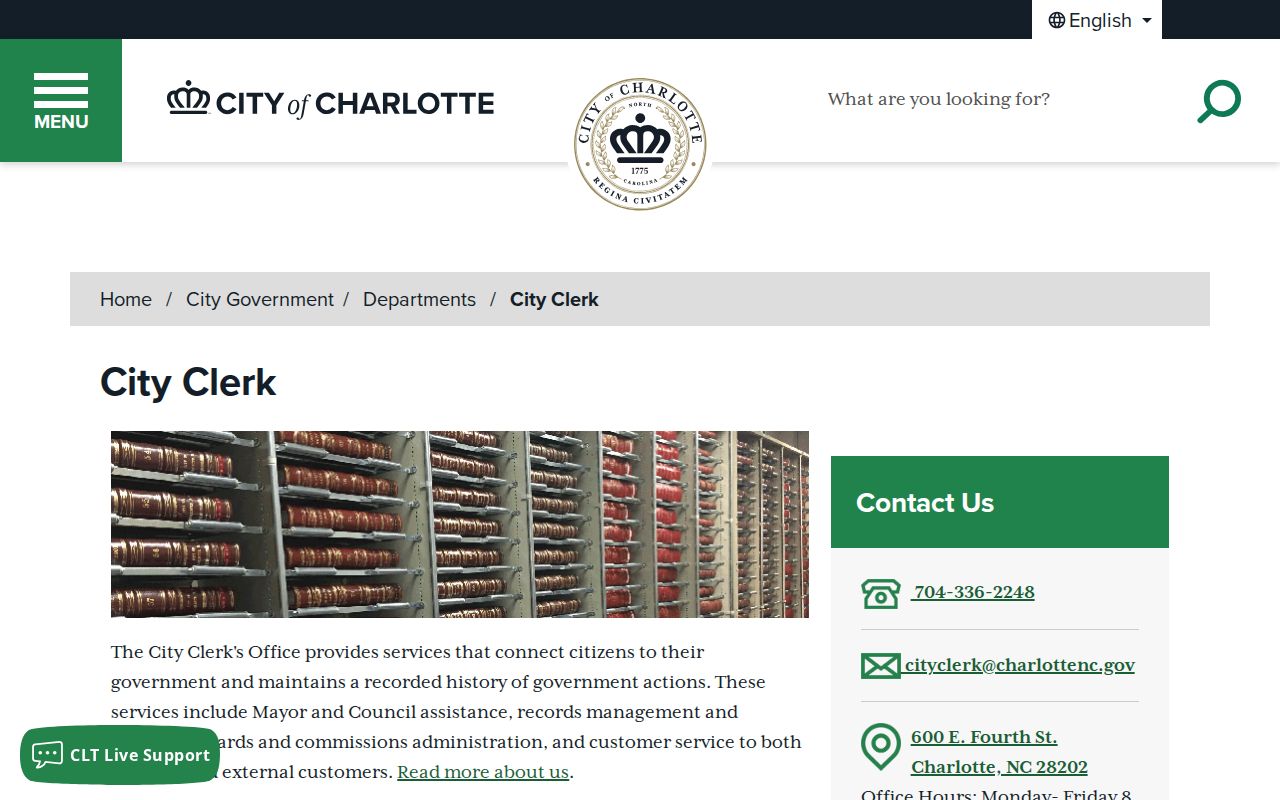
The referral sends a Charlotte court docket search onward to the state judiciary. No city municipal court stands in the way.
Court Dates and Settings in Charlotte
Every Charlotte court date is case-specific. Begin in the Hearings area of the Case Summary. Then use Portal's Search Hearings tool to confirm the current Charlotte setting by case number or party name. Mecklenburg's local administrative schedules add courtroom assignments, court division, and session context. A posted calendar category helps. It never replaces the current hearing tied to the Charlotte case.
When a Charlotte hearing looks moved, chase the latest case event and the latest hearing entry. A continuance postpones a setting. A reset means an older setting shifted. A calendar call organizes an upcoming session, not a trial result. For time-sensitive court dates, confirm through Caseflow Management or the Clerk after checking the electronic record.
| Date | The current Charlotte-related hearing date shown in Search Hearings or the Case Summary. |
|---|---|
| Time | The scheduled hearing or session time, which may differ from a calendar-call time. |
| Courtroom | The Mecklenburg courtroom assigned to the state-court setting. |
| Judicial officer | An available Search Hearings field used to narrow a Charlotte case setting. |
| Setting type | The event label, such as a motions calendar, trial calendar, first appearance, or calendar call. |
Charlotte Court Date Check
What if the Charlotte Portal disagrees with your printed notice? Treat the newer hearing information as the working record. Then confirm it before you act. Search Hearings lets you query by case number, party, business, attorney, judicial officer, courtroom, or date range. It is built for current calendar checks, while Smart Search gives the fuller Case Summary. Do not read a court date out of an old event line or a stale trial order. Do not trust a blank schedule category either.
When a hearing is close, ask the Clerk. The same goes when a case has been continued or a Portal result stays murky. Or use the Mecklenburg Caseflow Management page to reach local scheduling staff. They can point you to the right records channel fast. Keep the appearance date on your printed notice. That holds unless the court confirms a change in writing.
Traffic Tickets in Charlotte
A Charlotte traffic ticket lives in the Mecklenburg state District Court docket. There is no separate Charlotte municipal court handling it. Smart Search takes a citation number, party name, or case number. The Mecklenburg location filter trims statewide results down to the county. Once you find the citation, run Search Hearings to verify the date, time, and courtroom. The citation itself prints a court date. A missing online payment result does not erase that obligation.
Some tickets can be resolved before the court date if they qualify for payment. Others require an appearance. Portal's payment feature depends on eligibility. A citation may be missing because it demands an appearance, has not been entered yet, is not payable online, or has a data-entry problem. The Mecklenburg traffic tickets resource covers countywide payment and court-date detail. For Charlotte itself, the route stays Portal, the Clerk, and District Court.
Note: A live Portal payment screen is not permission to ignore the date printed on a Charlotte citation.
Charlotte Citation District Route
Every Charlotte-issued citation follows one state-court route. Contact the issuing agency or the city, note the citation or case number, then use Portal, Mecklenburg District Court, and the Clerk. Superior Court enters the picture only if the case belongs there or arrives on appeal. Traffic and infraction matters start in District Court. So do most Charlotte misdemeanors. Felonies and major proceedings sit in Superior Court. The city name adds no extra trial-court docket tier.
A District Court appeal to Superior Court gets a brand-new trial, not a review of the old record. If you spot an appeal in a docket, check the case information for the division now handling it. Ask the Clerk when the relationship is unclear. The public Case Summary and its cross-references beat any guess drawn from a courtroom label or a city address.
Docket flow: Charlotte city contact or issuing agency › citation or case number › North Carolina eCourts Portal › Mecklenburg District Court or Clerk › Superior Court when that division has jurisdiction.
Where Charlotte Cases Go
Charlotte cases land in whichever Mecklenburg state court has jurisdiction over that case type. The local system runs on the District and Superior divisions of the North Carolina General Court of Justice. Magistrates sit inside the District Court Division. So Charlotte civil, criminal, family, estate, small-claims, and traffic records all live in the county Clerk's unified records structure. That holds even when the underlying event happened inside the city.
The main courthouse and its public terminal sit at 832 East Fourth Street in Charlotte. That is the fallback for a few things. It applies when a Charlotte court docket is not fully online, when a paper file needs inspection, or when you want a Clerk copy. For countywide depth, see the Mecklenburg County court docket overview. The key Charlotte point is simple: the same state-court route serves city cases.
Charlotte Court File Sources
A Charlotte police report or city record is not a state-court Case Summary. The Case Summary is the court chronology. It can show case information, assignments, parties, events, and hearings. It also covers dispositions, financial information when applicable, and available documents. City-held records follow their own rules. A Charlotte court record search should start with the state court channels. Not every city record shows up in Portal.
Federal cases sit outside any Charlotte state-court docket. The Western District of North Carolina CM/ECF information describes the federal court's electronic setup. That setup includes filing and docketing. Federal access runs through that court and PACER, not Portal or the Mecklenburg Clerk. Keeping the two systems straight keeps a search pointed at the right docket.
The official system information from the federal court describes that electronic setup.
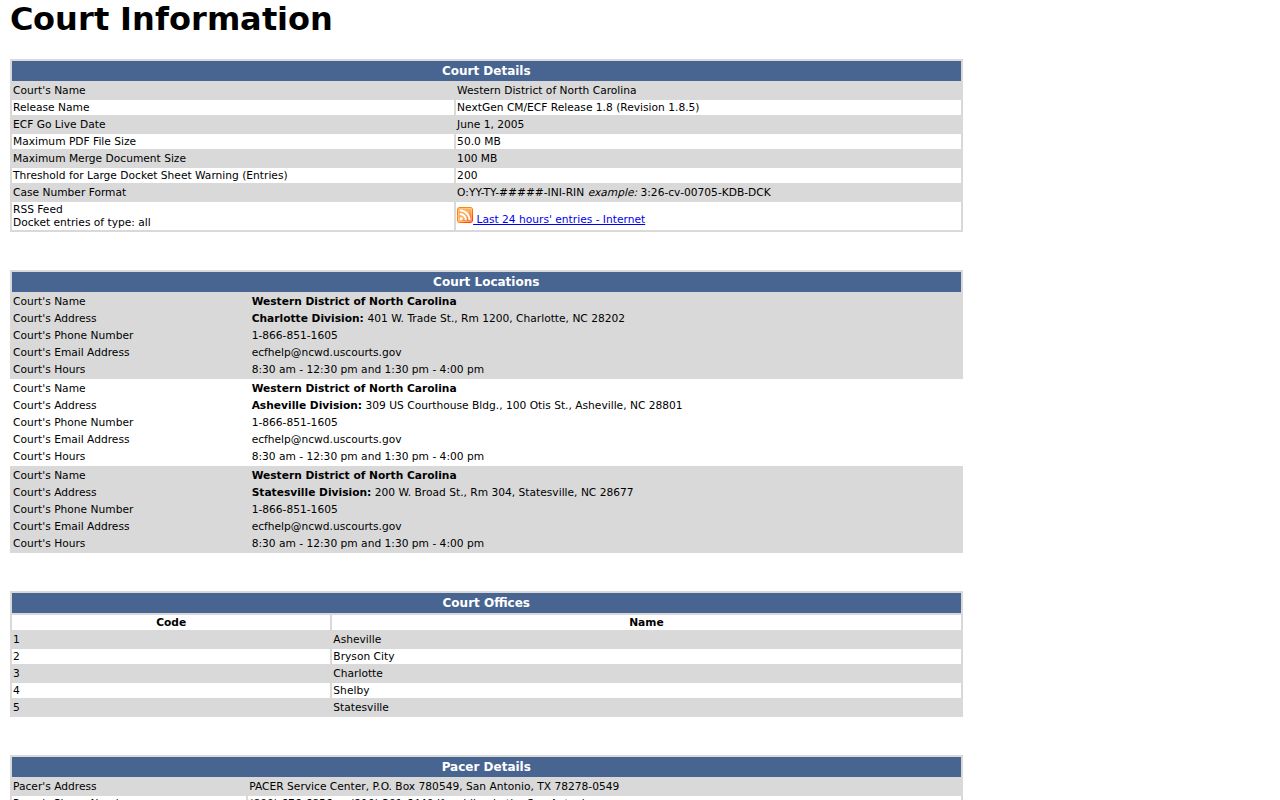
The practical rule holds either way. A Charlotte state court record and a federal docket run on different official systems.
Charlotte Court Record Access Rules
Most Mecklenburg court records sit open to the public in the state system. A law or a court order can close a file. That is the exception in Charlotte. Portal gives a handy public view. Yet the Clerk of Superior Court still keeps the official record. At the Clerk's office, anyone can read paper files that are on hand. The public self-service terminals are open to anyone too.
Older paperwork is a different matter. Files from before the county's October 9, 2023 eCourts conversion may be missing from view. You may have to ask the right Clerk division. Name the record type, the party, and the file number if you have it. Registering an account changes none of this. Sealed files, juvenile matters, adoptions, and other confidential records stay closed no matter who asks. A gap in the docket does not mean no case exists. The Clerk can point you to the proper channel. But only the court rules when a legal restriction is in play.
Key Rules:
G.S. 7A-109 requires the Clerk to maintain court records, dockets, and indexes and generally makes them open for public inspection unless law restricts access.
G.S. 1-72.1 supplies a procedure to assert access to a civil judicial record.
G.S. 7B-3000 restricts public inspection of juvenile records except for defined authorized access or a court order.
Charlotte Court File Fallback
The Portal may not have the Charlotte court document you need. The fallback depends on what you are asking for. Records that exist can be pulled at the Clerk counter or a public terminal. Documents from criminal, civil, or estate special proceedings filed before October 9, 2023 sometimes sit outside the online system entirely. For those, the county location page points you to the right Clerk division by email. Include the record type, the party name or names, and the file number if you know it.
Fees follow statute. Copies, certifications, and record searches are charged separately. Confirm the request and the cost with the Clerk before you order. The court's NCAOC public-records policies draw a line. On one side sit agency public-record requests. On the other sits a plain copy from a local court file. A Charlotte court docket view helps you find the right case. The Clerk remains the official channel for the file itself.
For the rules that govern these requests, the Judicial Branch public-records policy source sets out the Judicial Branch's requirements in full.
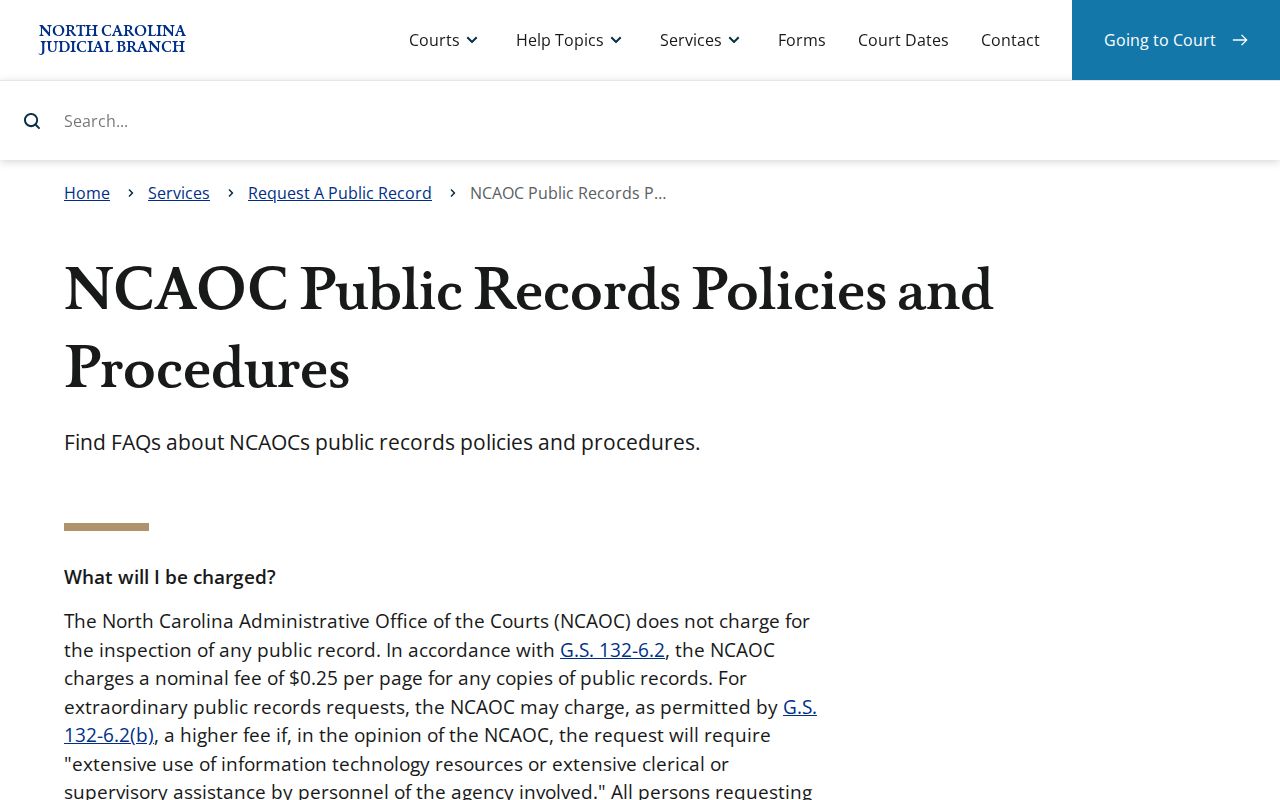
The policy is clear on where a Charlotte court file request belongs. Send it to the office that keeps the record you want.